

Clean energy employers carry more risk than most when they make a hiring decision. The work is evolving, team capacity is limited, and even when a candidate appears strong on paper, the biggest question is whether they will stay long enough to make a difference. That concern is what the Transform Power System (TPS) Workforce Hub is built to absorb, and Sade Mabawonku’s trajectory is an example of what that looks like in practice.
Sade entered TPS with a strong technical background. She holds a master’s degree in chemical engineering, but she was outside the energy sector and unsure how to pivot. She joined TPS in 2024 as a Project Development Fellow, completing the training sequence, the OSHA credential, and a skills-assessment process that translated her prior experience into energy-aligned roles.
As part of her project requirement as a TPS Fellow, Sade led a stakeholder engagement and program design process that brought clean-energy programming to the Hyde Park YMCA. “The project work wasn’t theoretical,” she said. “We wrote it, submitted it, and it got funded. That changed what I believed I could do.”
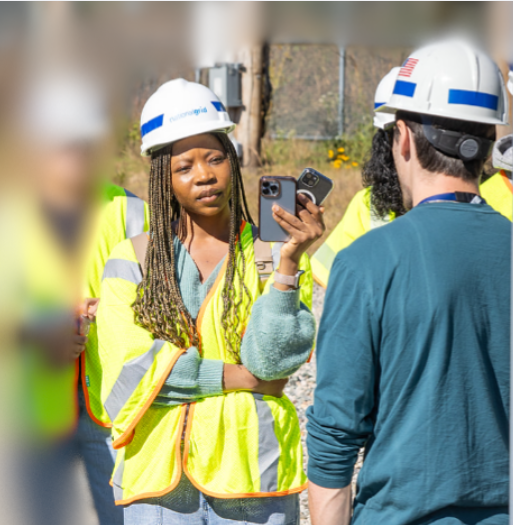
Sade Mabawonku and her cohort took their learning to the field in their work alongside National Grid personnel.
Her cohort was routed into the National Grid Clean Energy Career Academy. Sade completed the capstone with her team and won the top project, which positioned her to be championed internally. Within months, she was hired at National Grid as a senior project manager in distributed generation, and she is still there.
That continuity is strategic. Employers have shared that retention is a major pain point for their teams. Hiring for a position once is already expensive, and when there is turnover at a company, those costs can skyrocket.
TPS is designed to stabilize the first 12 months when churn risk is highest for employers. Sade saw an opportunity in clear energy and wanted to position herself and her skill set for success. “I knew I wanted to pivot [into the industry], but I didn’t know how to do it. Having people in the program actually look at me and say, ‘Here is the lane you can step into,’ changed everything.”
The human layer is what distinguishes the model. TPS convenes content, employers, and projects, but the mentorship and judgment applied inside the Hub is what makes the pipeline stick. “The TPS team gave me a sense of possibility in the middle of confusion,” Sade said. “It wasn’t automated. They listened and matched me based on what I could actually do.”

For employers, the outcome is a hire who arrives with sector vocabulary, relevant projects, and a support structure that extends beyond day one. For Sade, it is a durable foothold in a field she plans to stay in.
Today, Sade’s funded YMCA grant now stands up a new clean energy learning channel for residents of an environmental justice community — a downstream impact of one candidate receiving guided entry.
The clean energy sector will miss its targets without people who ramp and remain. Sade’s story shows what it looks like when the risk of the first year is held by someone other than the hiring manager, and why the TPS Workforce Hub has become a preferred on-ramp for employers who cannot afford to guess.